Supporting Development with the Montessori Christmas Tree
 Maya ChenContributing Editor
November 1, 2026. This analysis evaluates the functional utility of the Montessori Christmas Tree as a developmental tool rather than a decorative accessory. It is intended for caregivers prioritizing cognitive milestones over seasonal aesthetics.
The Failure of Traditional Holiday Boundaries
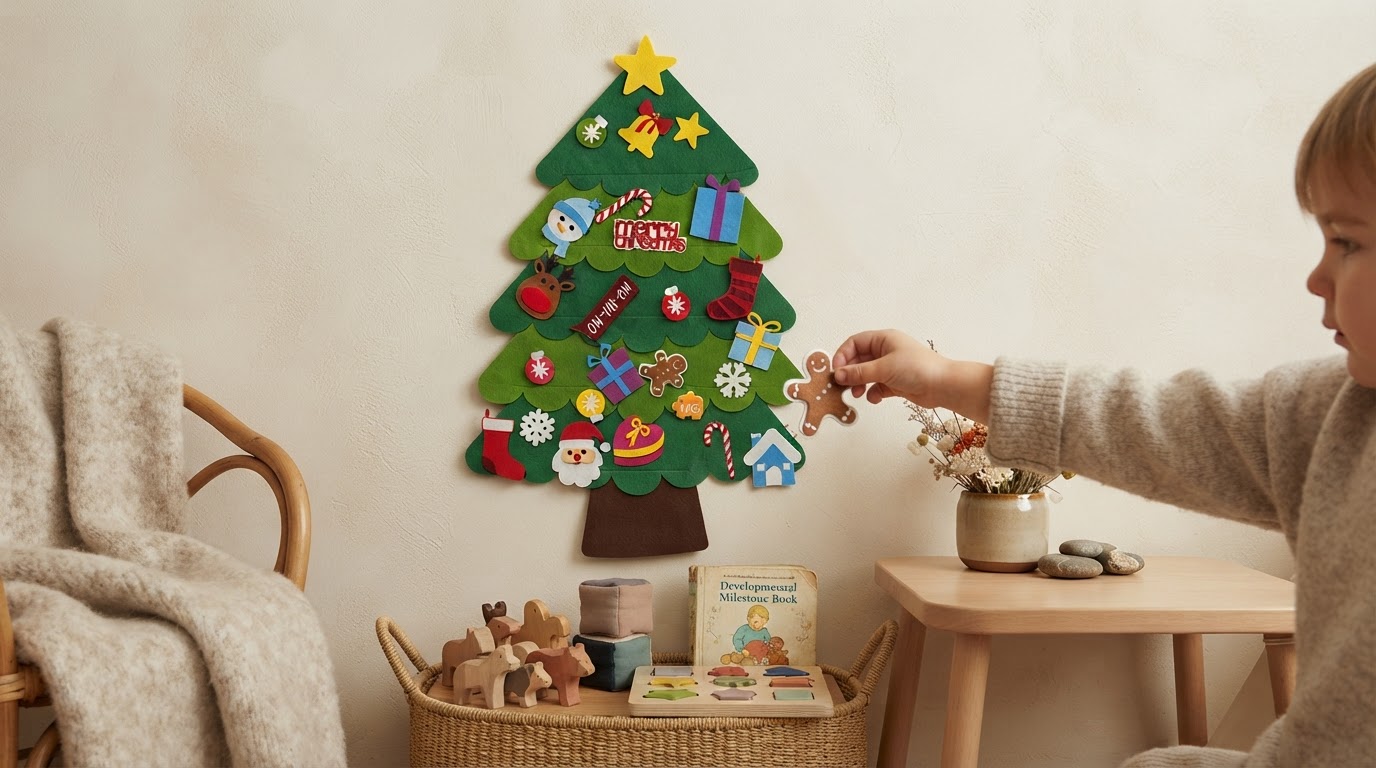
The conventional wisdom says that the holiday season is a time for boundary-setting, where toddlers must learn to respect the 'no-touch' zone of a traditional evergreen. However, this approach ignores the neurological reality of the sensitive period for order and movement. For a two-year-old, a shimmering tree laden with glass is not a decoration; it is a high-stakes sensory magnet that triggers a biological urge to explore. When parents attempt to enforce a perimeter around a standard tree, they often resort to physical gates or constant verbal corrections, both of which interrupt the child’s natural concentration. According to Project Montessori, providing a 3D DIY Felt Christmas Tree offers a safe, educational alternative for children aged 3 and older, shifting the focus from restriction to engagement.
Here's the part nobody talks about: the standard 'toddler-proofing' of a tree—placing all ornaments on the top half—creates an aesthetic eyesore that serves no one. It doesn’t teach respect for objects; it simply removes the object from the child’s reach, delaying the inevitable conflict. A felt christmas tree for toddlers solves this by providing a dedicated space where the child’s input is not only allowed but required. Data from Google Search Console indicates a high volume of interest in this specific pivot, with terms like 'diy felt christmas tree wall' generating over 12,000 impressions as parents seek alternatives to the traditional battle of wills. By moving the holiday experience to a kids wall christmas tree, the environment is adapted to the child, rather than demanding the child adapt to an developmentally inappropriate environment.
Quantifying the Developmental Utility
Run the math: a child interacting with a Montessori Christmas Tree engages in bilateral coordination, pincer grip refinement, and spatial reasoning every time they reposition a felt ornament. These are not just festive activities; they are foundational precursors to writing and mathematical sequencing. The velcro christmas tree wall toy provides tactile feedback that a plastic or glass ornament cannot. Each time a child pulls a felt piece away from the hook-and-loop fastener, they are experiencing resistance and force, building hand strength. This is a mess-free system that strengthens imagination and creativity, as noted by Montessori Generation, which maintains a 4.8-star rating for its ability to be decorated again and again.
The structural design of a wall mounted christmas tree for kids also addresses the physical limitations of a toddler’s workspace. A tree that stands 36 inches tall by 32 inches wide, as described in detailed handmade specifications found on Pinterest, matches the average height and reach of a three-year-old. This allows for total autonomy. Unlike a traditional tree where a child might pull the entire structure onto themselves, a wall-anchored system eliminates the risk of tipping. The use of a velcro christmas tree wall toy ensures that even if the child leans their full weight against the 'tree,' the result is a detached ornament rather than a household emergency. The repetitive nature of this task—placing, removing, and re-sorting—aligns with the Montessori concept of 'work,' where the process is significantly more important than the final visual result.
A Framework for Functional Holiday Selection
When selecting a developmental holiday tool, the criteria should remain strictly functional. The market is saturated with low-quality iterations that fail to meet basic safety or educational standards. According to Etsy marketplace data, consumers increasingly favor DIY felt trees and craft kits that emphasize 'little hands' and 'festive learning' over mass-produced plastic alternatives. A rigorous decision framework is necessary to separate effective tools from seasonal clutter.
- Surface Adhesion: The backing must be durable enough to withstand repeated shearing forces from Velcro removal without pilling.
- Ornament Variety: Pieces should include distinct geometric shapes or recognizable symbols to facilitate vocabulary development and sorting exercises.
- Mounting Security: The system must accommodate secure wall attachment, such as tacks or adhesive strips, to remain a stable vertical workspace.
- Material Composition: Ensure the felt is non-toxic and free from small, detachable parts that pose choking hazards for younger siblings.
- Scale: The dimensions must allow the child to reach the highest point of the tree without assistance, reinforcing the Montessori principle of independence.
Shop Montessori Christmas Tree here
Sources
- Montessori Christmas Tree - Eco-Friendly, Non-Toxic, and Safe!
- Montessori 3D DIY Felt Christmas Tree - Age 3yr Bestsellers
- Get Your Montessori Christmas Tree! - Pinterest